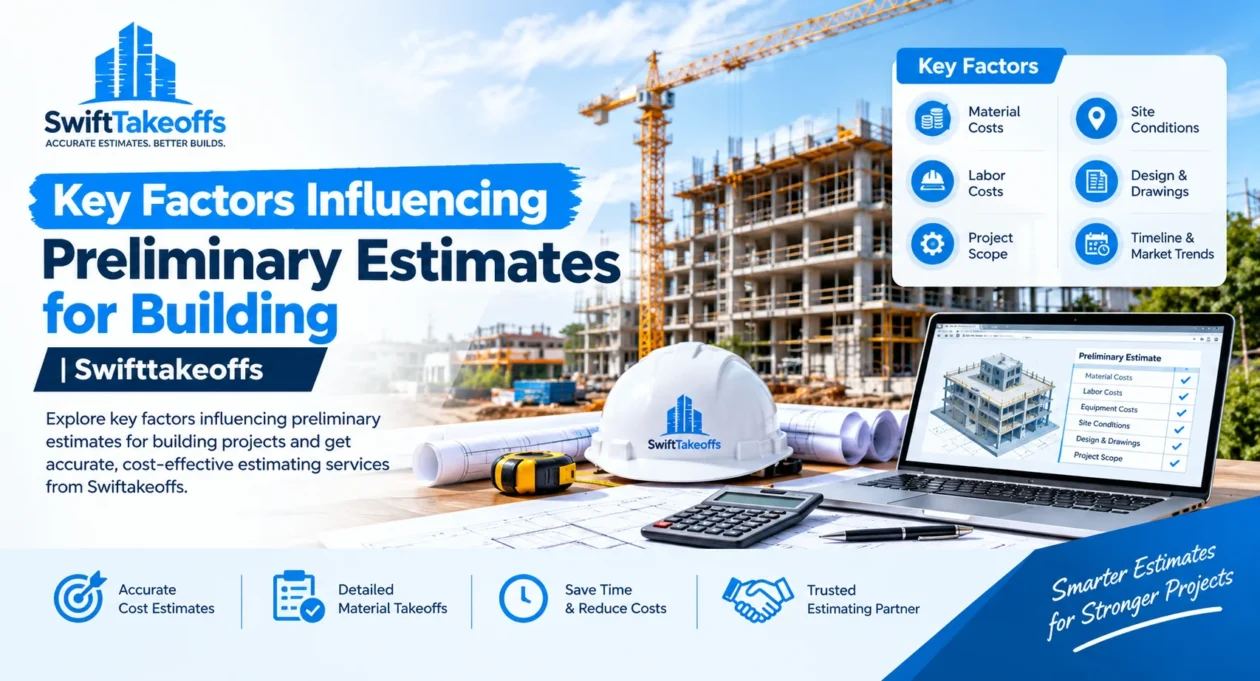
Key Factors Influencing Preliminary Estimates for Building
The key factors influencing preliminary estimates for building projects include scope, design, materials, labour, quantities, site conditions, location, size, complexity, market rates, and regulatory requirements. Swifttakeoffs considers these variables to support clearer early-stage construction budgeting and informed project decisions.
How Project Scope Affects Preliminary Construction Cost Estimates | Swifttakeoffs
Project scope determines which construction activities, materials, trades, and services belong in an early budget. Swifttakeoffs reviews the defined scope of work to create more dependable preliminary construction estimates while reducing costly assumptions and omissions.
A clear project scope gives your estimate a reliable starting point because it defines exactly what the project must deliver. Architectural work, structural construction, finishes, services, external works, demolition, and site preparation can all shift the budget. Swifttakeoffs uses available project requirements to establish sensible boundaries before estimating begins.
Your construction budget estimate becomes far more useful when inclusions and exclusions remain transparent. For example, a commercial refurbishment may involve asbestos surveys, temporary works, specialist installations, and phased occupancy. These details can materially change projected spending, which makes accurate scope definition essential for practical project cost planning from the outset.
How Building Design and Specifications Influence Cost Estimation | Swifttakeoffs
Building design influences cost through structural systems, layouts, finishes, building services, energy performance, and specification quality. Swifttakeoffs analyses available drawings and specifications to identify design-driven cost variables before they create unexpected budget pressure.
Strong building design can either simplify construction or introduce layers of complexity that increase spending. Your architectural plans establish areas, layouts, openings, finishes, and spatial relationships, while structural drawings determine foundations, framing, reinforcement, and load-bearing requirements. Swifttakeoffs connects these design details with realistic construction cost estimation during early budgeting.
Detailed project specifications also influence the quality of your estimate because premium finishes, specialist equipment, façade systems, and performance standards carry different prices. UK projects may also require compliance with applicable Building Regulations and planning conditions. Although early estimates remain provisional, stronger documentation helps a construction cost estimator reduce uncertainty substantially.
Why Material Costs Matter in Preliminary Building Estimates | Swifttakeoffs
Material costs can significantly change preliminary building estimates because specifications, quantities, supplier pricing, waste, transportation, and market volatility affect total expenditure. Swifttakeoffs evaluates available material information to develop practical allowances that support stronger early-stage budget forecasting.
Your construction material costs can move quickly when specifications change or supply conditions tighten. Concrete, steel, timber, insulation, glazing, finishes, and mechanical equipment each respond differently to market pressures. A useful preliminary cost estimate therefore considers quantities alongside current pricing rather than applying one broad allowance across every building component.
Accurate material quantities create another important advantage because quantity errors multiply quickly across large projects. Swifttakeoffs can organise measurable requirements from drawings and specifications, helping you understand where expenditure concentrates. Transportation, wastage, storage, procurement timing, and supplier availability should also influence assumptions when developing construction pricing for early decisions.
How Labour Costs Impact Construction Cost Estimating | Swifttakeoffs
Labour costs depend on trade requirements, productivity, project duration, location, workforce availability, specialist skills, and working conditions. Swifttakeoffs incorporates labour-related considerations into preliminary estimates so projected construction expenditure reflects realistic delivery requirements.
Construction labour costs often represent a substantial share of total project expenditure, particularly where specialist trades or intensive installation work dominate. Your estimate should consider electricians, plumbers, bricklayers, carpenters, decorators, plant operators, and other required trades. Swifttakeoffs evaluates labour requirements alongside quantities to strengthen early construction estimating services.
Regional wage differences can also affect your projected budget because labour availability varies between markets. Difficult access, restricted working hours, accelerated programmes, and complex sequencing may reduce productivity and increase labour hours. When you compare labour rates, productivity assumptions, subcontractor requirements, and project duration together, the resulting construction cost analysis becomes considerably more realistic.
The Role of Quantity Takeoff in Accurate Preliminary Estimates | Swifttakeoffs
Quantity takeoff converts drawings and specifications into measurable quantities that underpin reliable construction pricing. Swifttakeoffs uses structured quantity assessment to connect project information with preliminary estimates and improve transparency across materials, labour, and construction activities.
A structured construction quantity takeoff turns drawings into measurable information such as floor areas, concrete volumes, reinforcement, masonry, doors, windows, finishes, and services. That information gives your quantity takeoff services a measurable foundation instead of relying on rough assumptions. Swifttakeoffs uses available documentation to support more consistent preliminary budgeting.
The quality of quantity measurement matters because even small errors can compound across a large building. Your estimate benefits when quantities remain traceable to drawings, specifications, and defined measurement rules. This approach also supports material takeoff services, helping contractors compare expected requirements with supplier quotations and improve estimate accuracy before tender preparation.
How Site Conditions Affect Building Cost Estimates | Swifttakeoffs
Site conditions can alter building costs through ground conditions, access, utilities, contamination, demolition, temporary works, logistics, and excavation requirements. Swifttakeoffs considers known site constraints when developing preliminary estimates so potential cost variables receive appropriate attention.
Unexpected site conditions can turn a seemingly straightforward project into a financial headache. Ground instability, contaminated soil, difficult access, buried utilities, drainage issues, and restricted storage can increase labour, plant, excavation, and temporary works costs. Swifttakeoffs incorporates available site information when preparing building cost estimation for early project decisions.
Site logistics deserve equal attention because your contractor may face limited delivery windows, neighbouring properties, traffic restrictions, or constrained working space. These factors can influence equipment requirements and productivity. Early surveys and site investigations provide stronger evidence, allowing professional construction estimating to reflect known constraints rather than treating every site as an identical construction environment.
Why Location and Market Rates Influence Construction Estimates | Swifttakeoffs
Project location affects construction estimates through regional labour rates, supplier pricing, transport expenses, workforce availability, and local market conditions. Swifttakeoffs considers location-specific information where available to improve the commercial relevance of preliminary construction estimates.
Location can reshape your budget because construction markets rarely behave uniformly across regions. Labour availability, supplier networks, transport distances, contractor competition, and local demand can influence pricing. Even projects with identical designs may produce different budgets when delivered in different locations. These regional differences are important inputs for project cost estimation.
Market conditions introduce another layer of uncertainty because inflation, material availability, interest rates, and tender activity can influence prices over time. Your local construction rates should therefore align with the estimate’s intended pricing period. Swifttakeoffs can structure assumptions around available market information, helping your cost estimating services remain commercially meaningful.
How Project Size and Complexity Affect Construction Cost Estimation | Swifttakeoffs
Building size and project complexity influence costs through quantities, structural requirements, services, specialist trades, coordination, sequencing, and management demands. Swifttakeoffs assesses these characteristics to produce more useful preliminary construction estimates than simple cost-per-area assumptions alone.
Building size provides an important cost indicator, but square metres never tell the complete story. A larger project may achieve purchasing efficiencies, while an intricate smaller building can demand expensive specialist work. Building size should therefore sit alongside structural form, storey count, floor layouts, services, and construction methods when forecasting expenditure.
Complex projects often require additional coordination, temporary works, specialist subcontractors, commissioning, testing, and phased construction. Your estimate should capture these requirements rather than applying a generic rate. Swifttakeoffs considers project complexity, interfaces, programme demands, and specialist systems when developing construction project estimating that better reflects actual delivery conditions.
How Swifttakeoffs Provides Reliable Preliminary Construction Estimating Services | Swifttakeoffs
Swifttakeoffs provides preliminary construction estimating services by reviewing project information, assessing quantities, considering labour and material costs, and organising assumptions into a structured estimate. This process helps contractors, developers, and project stakeholders establish clearer budgets before detailed estimating or procurement.
Reliable preliminary estimating services begin with disciplined document review rather than guesswork. Swifttakeoffs can assess drawings, specifications, quantities, project scope, and available pricing information before developing the estimate. The resulting cost breakdown helps you identify major expenditure categories, understand assumptions, and spot potential budget risks before committing resources.
You can also use outsourced estimating support when internal teams face demanding workloads or tight tender deadlines. Swifttakeoffs supports outsourced construction estimating by organising project information into practical cost data for decision-making. Whether you need contractor estimating services, quantity assessment, or early budget forecasting, a structured estimate gives your team stronger commercial visibility.
Book Swifttakeoffs Estimating Services
If you need a dependable preliminary construction estimate, Swifttakeoffs can help assess your drawings, quantities, specifications, labour requirements, and material allowances. Request Swifttakeoffs estimating services to move from uncertain early assumptions towards a clearer, evidence-based project budget.
When you need to get a construction cost estimate, providing complete drawings, specifications, project scope, location, and available pricing information can improve the assessment. Swifttakeoffs can then organise the relevant cost variables into a practical preliminary estimate, giving you clearer visibility before tendering, procurement, or further design development begins.
FAQS
1. What factors influence preliminary building estimates?
Answer: Project scope, design, material prices, labour rates, site conditions, location, building size, complexity, and market conditions can all influence preliminary building estimates.
2. Why is quantity takeoff important for preliminary estimates?
Answer: Quantity takeoff converts drawings and specifications into measurable quantities, helping create more accurate material, labour, and construction cost estimates.
3. How do site conditions affect construction costs?
Answer: Ground conditions, site access, utilities, contamination, excavation, logistics, and temporary works can increase construction costs and affect preliminary estimates.
4. Can Swifttakeoffs provide preliminary construction estimates?
Answer: Yes. Swifttakeoffs provides preliminary estimating services by assessing project documents, quantities, materials, labour requirements, and relevant cost variables.
5. Why should I hire professional construction estimating services?
Answer: Professional estimating services can improve budget accuracy, identify potential cost risks, support tender preparation, and provide clearer financial planning before construction begins.
For More Information Keep Visiting swifttakeoffs.